V & T Rolling Stock Downloads
Click on the screenshot to download from the DLS.
Scroll down to browse, or click on the category below to jump to that section
Locomotives
Passenger cars
Freight Cars
MoW
Motorcars
Locomotives
| Screenshot | Description | Source file(s) |
<KUID2:124060:1018:5> 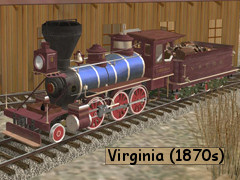
<KUID2:124060:1006:4> |
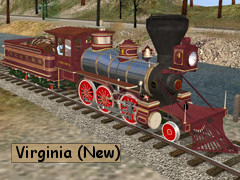
Locomotive No 4 (Virginia)'Virginia' was one of six 2-6-0's built by Baldwin Locomotive Works from 1869 through 1870 for the Virginia & Truckee Railroad. She was used as the Virginia City switch engine from 1869 to 1900. In 1910, she was retired to the Carson City engine house, and was scrapped in 1918. Drivers: 48 in Three levels of detail; 15068 / 3855 / 913 polygons for the new version, 14988 / 3879 / 977 polygons for the 1870's version. A matching tender is also available: As built and 1870's version This model is based on Ben Neal's (bdaneal) Inyo model; modified with permission. The as-built model was updated August 26 2015: Updated paint scheme and model details based on research by Jim Wilke, Randy Hees, and Andrew Brandon. Rebuilt the tender from scratch; using plans from Mike Collins. Version: TS2009 and later for the 1870's version; TS12 for the updated as-built model Version: TS12 |
Original GMAX and PSD source files (19 MB) Updated Locomotive Blender and PSP source files (10 MB) New Tender Model (26 MB) |
<KUID2:124060:1004:4> |
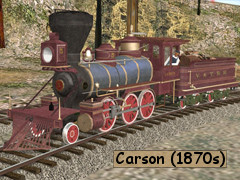
Locomotive No 5 (Carson)'Carson' was one of eight nearly identical 2-6-0's built by Baldwin Locomotive Works from 1869 through 1873 for the Virginia & Truckee Railroad. She was sold in Feb. 1883 to D. O. Mills (Onderdonk Construction), contractor for the Canadian Pacific Railway line of the Canadian government in British Columbia, and was lettered CP # 4 Savona. Resold 1887 to Intercolonial Railway in Nova Scotia, she became ICR number 190. ICR rebuilt 190 to 0-6-0 type in 1908, and she was renumbered to ICR 1025. She became Canadian Government Railway with same number, and later Canadian National Railway number 7083. In 1926, she was scrapped. Drivers: 48 in Three levels of detail; 15068 / 3855 / 913 polygons A matching tender is also available. This model is based on Ben Neal's (bdaneal) Inyo model; modified with permission. Version: TS12 |
|
<KUID2:124060:1010:4> |
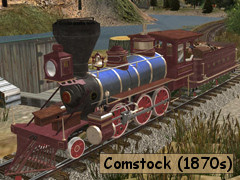
Locomotive No 6 (Comstock)'Comstock' was one of eight nearly identical 2-6-0's built by Baldwin Locomotive Works from 1869 through 1873 for the Virginia & Truckee Railroad. In 1881, she was sold to the Oregon Railway and Navigation Company as #41. In 1890, she was renumbered to Union Pacific #1378, then back to OR&N #15 in 1894. Drivers: 48 in Three levels of detail; 14845 / 4050 / 911 polygons A matching tender is also available. This model is based on Ben Neal's (bdaneal) Inyo model; modified with permission. Version: TS12 |
|
<KUID2:124060:1012:4> |
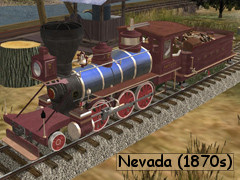
Locomotive No 7 (Nevada)'Nevada' was one of eight nearly identical 2-6-0's built by Baldwin Locomotive Works from 1869 through 1873 for the Virginia & Truckee Railroad. After a hard life as a freight engine, in 1883 she was sold to Sold to D. O. Mills for $8,500. Relettered by the V&T Carson City Shop to #5 Lytton, and used to help build the Canadian Pacific. In 1887, she was relettered for Intercolonial Railway #191, working in New Brunswick (eastern Canada). In 1912, she was renumbered to #1026. The next year, she was relettered to Canadian Government Railways. In 1914, she was rebuilt as an 0-6-0, but that didn't last long. She was sold for scrap in 1917. Drivers: 48 in Three levels of detail; 14964 / 3879 / 977 polygons A matching tender is also available. This model is based on Ben Neal's (bdaneal) Inyo model; modified with permission. Version: TS12 |
|
<KUID2:124060:1014:4> |
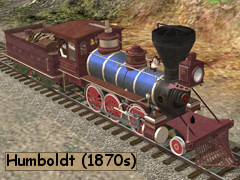
Locomotive No 8 (Humboldt)'Humboldt' was one of eight nearly identical 2-6-0's built by Baldwin
Locomotive Works from 1869 through 1873 for the Virginia & Truckee Railroad. Drivers: 48 in Three levels of detail; 14844 / 3855 / 913 polygons A matching tender is also available. This model is based on Ben Neal's (bdaneal) Inyo model; modified with permission. Version: TS12 |
|
<kuid:315087:1103> |
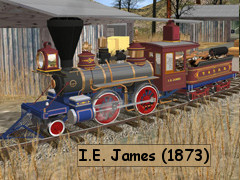
Locomotive No 9 (I.E. James)Built in 1870 by Baldwin Locomotive Works, the I.E. James was used as a switch engine at Carson City. In 1873, she started a fire at the Mexican Mill, destroying the wood yard. Shortly thereafter, she was fitted with a steam-powered water pump for fighting fires. In 1900, she was rented to the Boca and Loyalton Railroad, and was retired in 1905. In 1907, she was sold to contractors in Oakland and was converted to burn oil. She was finally scrapped in 1941. Drivers: 48 in A matching tender is also available. Model by Terry Bryson (tbryson2) Version: TRS2004 - TC2 (animated bell only functions in TS2006 and later) |
|
<KUID2:124060:1016:5> |
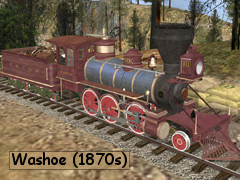
Locomotive No 10 (Washoe)'Washoe' was one of eight nearly identical 2-6-0's built by Baldwin Locomotive Works from 1869 through 1873 for the Virginia & Truckee Railroad. She was sold in 1881 to Oregon Railway and Navigation Company, and was renumbered OR&N #42. In 1894, she was renumbered #16. In 1900, she became Union Pacific #1379. She then went to the forests of western Washington, where she was eventually scrapped. Drivers: 48 in Three levels of detail; 15144 / 3855 / 913 polygons A matching tender is also available. This model is based on Ben Neal's (bdaneal) Inyo model; modified with permission. Version: TS12 |
|
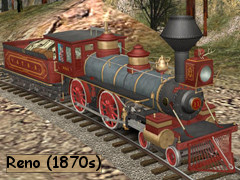 |
Locomotive No 11 (Reno)'Reno' was built in 1872 by Baldwin locomotive works. She is the oldest V&T locomotive still existing today. Reno was the favorite locomotive of the V&T, and was nicknamed 'Brass Betsy'. She was kept polished her entire life, and was the primary locomotive to pull the express train between Reno and Virginia City. Originally a wood burner, she was converted to coal in 1876, and to burn oil in 1907. She was the first V&T locomotive converted to burn oil. In 1945, she was sold to the movie studios, where she performed in over 20 movies, TV shows, and commercials. She is currently residing at Old Tuscon, where she has been cosmetically restored following a devastating fire in 1995. Drivers: 56 3/4 in Model by Ben Neal (bdaneal); links take you to his site, Subpar Productions. Also requires V&T Common files and Cabin for Reno, Genoa Version: TRS 2004 - TC2 |
|
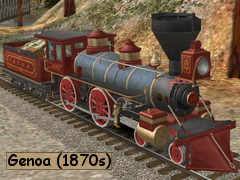 |
Locomotive No 12 (Genoa)Genoa was built in 1873 by Baldwin. Very similar to 'Reno', she would pull the express when 'Reno' was out of service due to an accident or maintenance. Otherwise, she pulled other passenger or mixed trains, and occasionally freight. Never converted to coal or oil, 'Genoa' has remained a wood burner her entire life. She was retired in 1908, and sold in 1938. She now resides at the California State Railroad Museum, restored to her 1902 appearance. Drivers: 56 3/4 in Created by Ben Neal (bdaneal); links take you to his site, Subpar Productions. Also requires V&T Common files and Cabin for Reno, Genoa Version: TRS 2004 - TC2 |
|
<KUID2:124060:1022:5> |
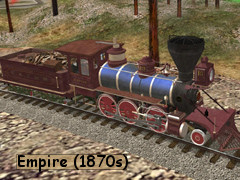
Locomotive No 13 (Empire)'Empire' was one of eight nearly identical 2-6-0's built by Baldwin Locomotive Works from 1869 through 1873 for the Virginia & Truckee Railroad. Built in 1873, she spent a long life as a freight engine on the V&T. In 1910, she was renumbered #15 due to the bad luck associated with her previous number. In 1924, she was sold to the Pacific Portland Cement Company, Gerlach, Nevada as #501. In 1938, Empire was presented to the Pacific Coast Chapter of the Railway and Locomotive Historical Society for preservation. She is now on display at the California State Railroad Museum, restored to her 'as built' appearance. Drivers: 48 in Three levels of detail; 15144 / 3855 / 913 polygons A matching tender is also available. This model is based on Ben Neal's (bdaneal) Inyo model; modified with permission. Version: TS12 |
|
<KUID2:124060:1024:6> |
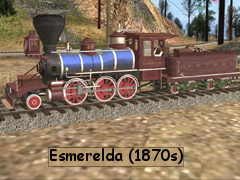
Locomotive No 14 (Esmeralda)'Esmeralda' was one of eight nearly identical 2-6-0's built by Baldwin Locomotive Works from 1869 through 1873 for the Virginia & Truckee Railroad. Built in 1873, she ended service on the V&T just before the turn of the century (1897). In 1901, she was sold to Colonel Edgar K. Smoot, a railroad contractor in Manzanillo, Mexico for $2,000 From there, she went to the Mexican Government Railway, where she spent approximately the next 50 years. She is presumed to have been scrapped in Mexico at the end of her service there. Drivers: 48 in Three levels of detail; 15080 / 3855 / 913 polygons A matching tender is also available. This model is based on Ben Neal's (bdaneal) Inyo model; modified with permission. Version: TS12 |
|
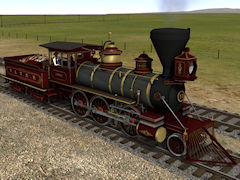 |
Locomotive No 19 (Truckee)'Truckee' was one of four nearly identical 2-6-0's built by Baldwin Locomotive Works from 1875 through 1876 for the Virginia & Truckee Railroad. These moguls are of a similar, albeit heavier, construction than the preceding eight Baldwin moguls. Built in 1875, Truckee ended service on the V&T just before the turn of the century (1892). In 1901, Verdi Lumber Company and renamed #1 Roberts. She was scrapped in 1920. Drivers: 48 1/4 in Built by Trainboi1 and hosted at Trainz-Forge. Version: TS2009 SP2 and later |
|
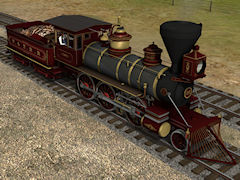 |
Locomotive No 20 (Tahoe)Built by Trainboi1 and hosted at Trainz-Forge . 'Tahoe' was one of four nearly identical 2-6-0's built by Baldwin Locomotive Works from 1875 through 1876 for the Virginia & Truckee Railroad. These moguls are of a similar, albeit heavier, construction than the preceding eight Baldwin moguls. Built in 1875 as a wood-burner, Tahoe was converted to coal in 1907, then to oil in 1911. She was placed out of service in the Carson engine house in 1926. In 1942, she was sold to a contractor for WWII work. After the was, she was again out of service. In 1968, she was sold to the Pennsylvania Historic and Museum Commission for preservation. She now resides in the Railroad museum of Pennsylvania at Strasburg. Drivers: 48 1/4 in Version: TS2009 SP2 and later |
|
<kuid:315087:1091> |
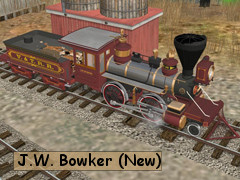
Locomotive No 21 (J.W. Bowker)Built in February 1875 by Baldwin, No. 21 was the second 2-4-0 on the V&T, after the largely identical No 9 (I.E. James). She was purchased to assist the Virginia City switch engine (No. 4, Virginia). With a built-in fire pump, she was frequently called to assist putting out fires near the tracks. In 1876, she was renamed "Mexico". She was sold to Sierra Nevada Wood and Lumber Company in 1896. In July of 1937, she was presented to the Railway and Locomotive Historic Society Inc. for preservation. She took part in the 1939 New York World's Fair, and also starred in the Paramount Pictures movie "Union Pacific". She now resides at the California State Railroad Museum, restored to her 1880s-1890s appearance. Drivers: 48 1/4 in A matching tender is also available. Created by Terry Bryson (tbryson2). Version: TRS2004 - TC2 (animated bell only functions in TS2006 and later) |
|
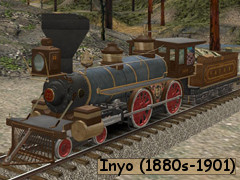 |
Locomotive No 22 (Inyo)Other than the famous 'Reno' steam locomotive, the second most popular iron horse on the V&T was the 'Inyo'. Built by Baldwin in 1875, she arrived in Reno on March 22, along with the J. W. Bowker. The wood burner cost $9,065 and when filled to capacity with approximately 2,000 gallons of water and three cords of wood, weighed over 58 tons. By 1879, the brass bedecked engine was employed in the V&T's regularly scheduled mixed passenger and freight service. At other times it substituted for the 'Reno' and 'Genoa' when they were in the shop. Beginning in the 1890's, No. 22 handled the road's crack Virginia City express train and saw extensive use during the Tonopah mining boom soon after 1900. In 1910, the 'Inyo' was next to the last of the V&T iron horses to be converted to burn oil. From 1926 on, the engine was considered to be retired, although she did replace the 'Reno' occasionally. Sold to the movie studios in 1935, she went on to star in more than 20 movies. She now resides at the Nevada State Railroad Museum, restored to a circa 1895 appearance. Drivers: 57 in Created by Ben Neal (bdaneal); links take you to his site, Subpar Productions. Also requires V&T Common files and Cabin for Inyo Version: TRS 2004 - TC2 |
|
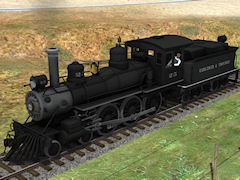 |
Locomotive No 25Built in 1905 as a coal-burner, No. 25 was converted to oil in 1907. She was sold to the movies in 1947, and is now on display (and running!) at the Nevada State Railroad Museum. Drivers: 60 in Built by Trainboi1 and hosted at Trainz-Forge. Version: TS2010 SP4 and later |
|
Passenger cars
| Screenshot | Description | Source file(s) |
<kuid2:124060:10075:1> |
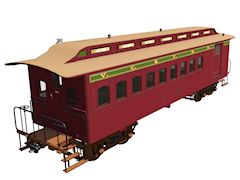
V & T Coach-Caboose No. 1 (1st)Built in 1869 in the V&T's Virginia City shops. The car was refurbished in 1873 and renumbered to No. 8. This model depicts the car as-built. Version: TRS19 or TRS22 Beta |
|
<kuid2:124060:10076:1> |
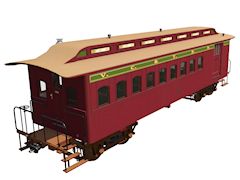
V & T Coach-Caboose No. 2 (1st)Built in 1870 in the V&T's Virginia City shops. The car was refurbished in 1873 and renumbered to No. 7. This model depicts the car as-built. Version: TRS19 or TRS22 Beta |
|
<kuid:124060:10027> 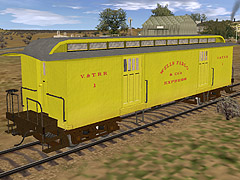
<kuid2:124060:10006:1> |
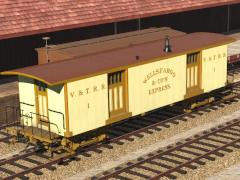
V & T Express Car No 1Industry interactive (carries express cargo). Built in 1872; the clerestory and straight air brakes were added in 1874. The car was destroyed in a fire at Old Tucson in 1995. Version: TRS19 or TRS22 Beta |
GMAX and PSD source files (11 MB) |
<kuid:124060:10028> 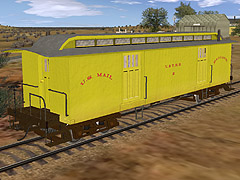
<kuid2:124060:10007:1> |
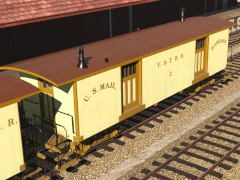
V & T Baggage / Mail Car No 2Industry interactive (carries baggage and mail cargo). Built in 1872; the clerestory and straight air brakes were added in 1874. This car was built into a house in Carson City, NV, where it remains to this day. Version: TRS19 or TRS22 Beta |
GMAX and PSD source files (15 MB) |
<kuid:124060:10029> 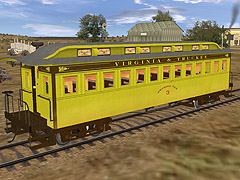
<kuid2:124060:10008:2> |
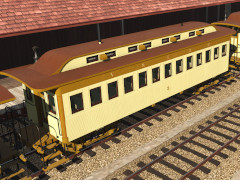
V & T Coach No 3Industry interactive (carries Western Passengers). Built in 1872. Air brakes were added in 1874. In 1878, this car was designated as a smoking car. This car is awaiting restoration at the Nevada State Railroad Museum. Version: TRS19 or TRS22 Beta |
GMAX and PSD source files (10 MB) |
<kuid:124060:10029> 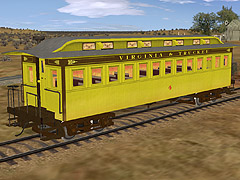
<kuid2:124060:10009:2> |
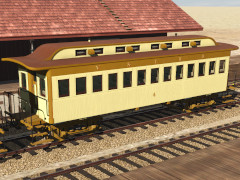
V & T Coach No 4Industry interactive (carries Western Passengers). Built in 1872. Air brakes were added in 1874. This car has been restored to mid 1880s appearance, and is on display at the Nevada State Railroad Museum. Version: TRS19 or TRS22 Beta |
Same as car No. 3 |
<KUID2:124060:10032:2> 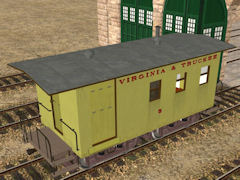
<KUID2:124060:10034:2> |
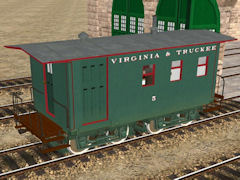
V & T Coach-caboose No 5Industry interactive; carries 2 baggage and 10 passengers. Caboose number 5 was built 1871 by the Virginia & Truckee in their Virginia City Shops. Originally numbered #3, it was renumbered to #5 in 1872 when the 4 Kimball cars were received. It was out of service by June, 1897, and eventually scrapped. Version: TRS19 or TRS22 Beta |
GMAX and PSD source files (9.4 MB) |
<KUID2:124060:10033:2> 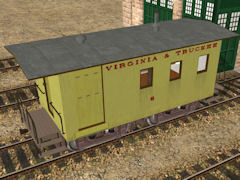
<KUID2:124060:10035:2> |
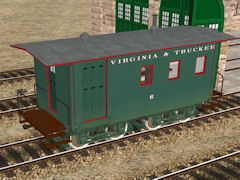
V & T Coach-caboose No 6Industry interactive; carries 2 baggage and 10 passengers. Caboose number 6 was built 1871 by the Virginia & Truckee in their Virginia City Shops. Originally numbered #4, it was renumbered to #6 in 1872 when the 4 Kimball cars were received. By June, 1897, No. 6 was being used as a carpenter sleeper. It received Tower couplers in 1902, but was scrapped not too long after; around 1905. Version: TRS19 or TRS22 Beta |
|
<kuid2:124060:15024:3> 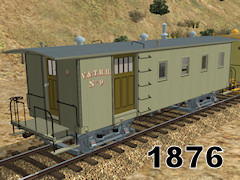
<KUID2:124060:15071:1> 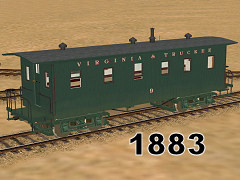
<kuid2:124060:15035:1> 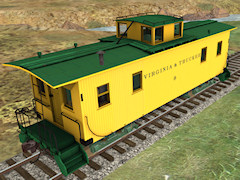
<KUID2:124060:15045:2> |
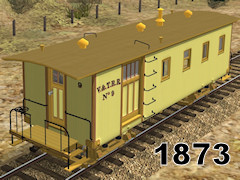
Caboose No 9Industry interactive. Depending on the version, it carries Western Passengers and baggage. This car was built in 1872, and is currently on display at the Nevada State Railroad Museum (restored to 1873 appearance). July 13 2015: The 1873 and 1876 versions have been updated to fix an error with TANE, as well as some minor fixes and optimizations. Version: TS12 |
for as built version for 1883 version GMAX and PSP source files (2.4 MB) GMAX and PSD source files (7 MB) |
<KUID2:124060:15027:3>
<KUID2:124060:15072:1> 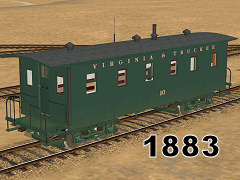
<kuid2:124060:15036:1> |
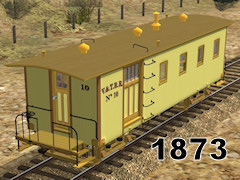
Caboose No 10Industry interactive. Depending on the version, it carries Western Passengers and baggage. This car was built in 1872, and is currently on display at the Nevada State Railroad Museum (restored to 1902 appearance). July 13 2015: The 1873 and 1876 versions have been updated to fix an error with TANE, as well as some minor fixes and optimizations. Version: TS 12 and later for the side door versions; TS 2009 and later for the 1883 version. Version: TS12 |
for 1883 version PSD source file (6.6 MB) |
<kuid2:648132:100227:1> 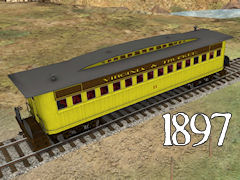
<kuid2:648132:100225:1> 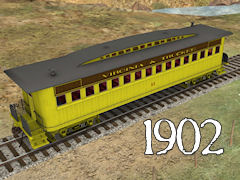
<kuid2:648132:100223:1> 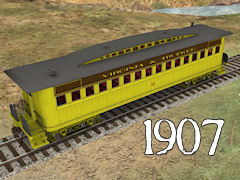
<kuid2:648132:100221:1> 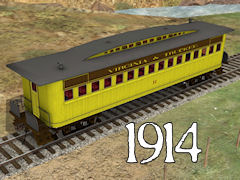
<kuid2:648132:100219:1> 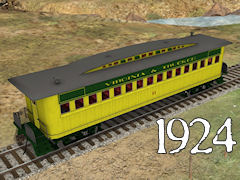
<kuid2:648132:100206:1> 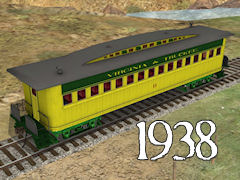
<kuid2:648132:100208:1> |
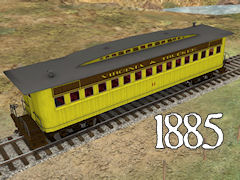
Coach No 12Industry interactive; carrying passengers. These cars were obtained from Brill in 1874 and are currently stored at the Nevada State Railroad Museum (unrestored). These models were created by Trainboi, and are now on the DLS. At TrainzForge, there is also a package that contains additional movie versions. Version: TS 2012 and later. |
|
|
<kuid2:648132:100226:1>
<kuid2:648132:100224:1>
<kuid2:648132:100222:1>
<kuid2:648132:100220:1>
<kuid2:648132:100218:1>
<kuid2:648132:100205:1>
<kuid2:648132:100207:1> |
Coach No 11Industry interactive; carrying passengers. These cars were obtained from Brill in 1874 and are currently stored at the Nevada State Railroad Museum (unrestored). These models were created by Trainboi, and are now on the DLS. At TrainzForge, there is also a package that contains additional movie versions. Version: TS 2012 and later. |
|
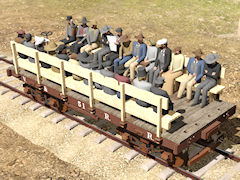
<KUID:124060:10077> |
V & T 24' picnic carA 24' flat car fitted with benches for additional passenger capacity - used for special events, excursions, picnics, etc. Version: TRS19 or TRS22 Beta |
|
Freight Cars
| Screenshot | Description | Source file(s) |
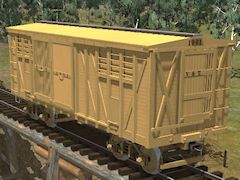
<kuid2:124060:15029:2> 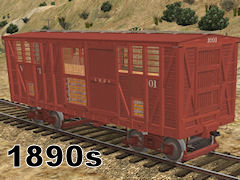
<kuid2:124060:15028:2> 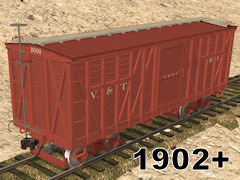
<kuid2:124060:15062:1> |
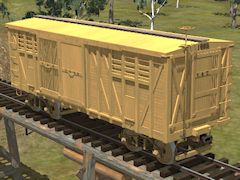
V & T combination boxcar 1001Built in 1872 by the Central Pacific shops in Sacramento, CA. Yellow car updated August 2018 with model corrections and optimizations; and fixed minor errors. Version: TANE |
for the 19th century version. for the post 1902 version. |
<KUID2:124060:15054:2> 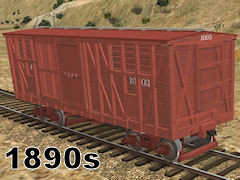
<kuid2:124060:15058:1> 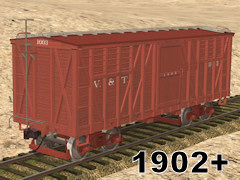
<kuid2:124060:15063:1> |
V & T combination boxcar 1003Built in 1872 by the Central Pacific shops in Sacramento, CA. Yellow car updated August 2018 with model corrections and optimizations; and fixed minor errors. Version: TANE |
|
<KUID2:124060:15055:2> 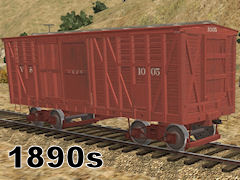
<kuid2:124060:15059:1> 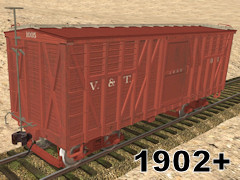
<kuid2:124060:15064:1> |
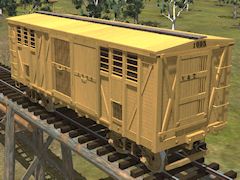
V & T combination boxcar 1005Built in 1872 by the Central Pacific shops in Sacramento, CA. Yellow car updated August 2018 with model corrections and optimizations; and fixed minor errors. Version: TANE |
|
<KUID2:124060:15056:2> 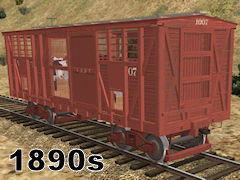
<kuid2:124060:15060:1> 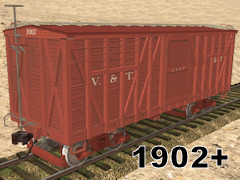
<kuid2:124060:15065:1> |
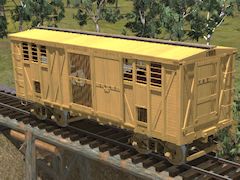
V & T combination boxcar 1007Built in 1872 by the Central Pacific shops in Sacramento, CA. Yellow car updated August 2018 with model corrections and optimizations; and fixed minor errors. Version: TANE |
|
<KUID2:124060:15057:2> 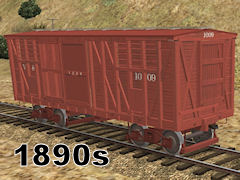
<kuid2:124060:15061:1> 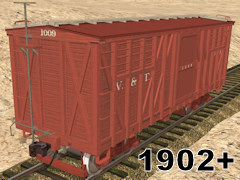
<kuid2:124060:15066:1> |
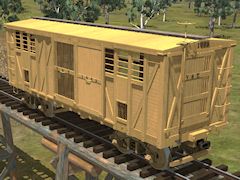
V & T combination boxcar 1009Built in December 1872 by the Central Pacific shops in Sacramento, CA. Yellow car updated August 2018 with model corrections and optimizations; and fixed minor errors. Version: TANE |
|
<kuid2:124060:15010:2> 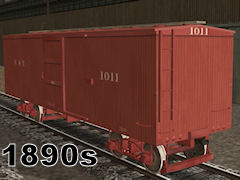
<kuid2:124060:15009:2> 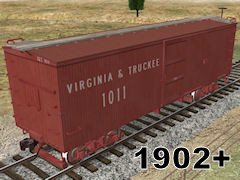
<kuid2:124060:15048:1> |
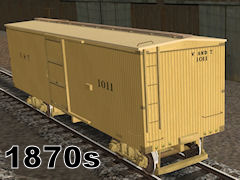
V & T boxcar 1011Built in 1874, this car is currently at the Nevada State Railroad Museum awaiting restoration. Carries hay and general goods.
Version: TRS2004 |
for the 19th century version. for the post 1902 version. |
<kuid2:124060:15012:2> 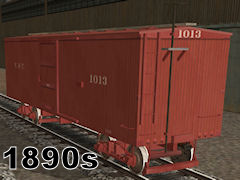
<kuid2:124060:15011:2> 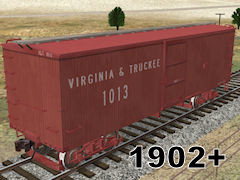
<kuid2:124060:15049:1> |
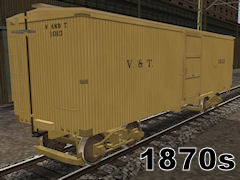
V & T boxcar 1013Built in 1874, this car is on display at the Nevada
State Railroad
Museum, restored to circa 1909. Version: TRS2004 |
for the post 1902 version |
<kuid2:124060:15019:2> 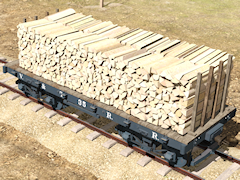
<kuid:124060:15085> 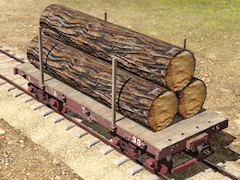
<kuid:124060:15084> |
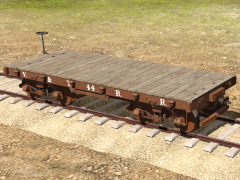
V & T 24' wooden flatcar (Central Pacific)Records are unclear, but it appears the Central Pacific built between 10 and 17 24' flat cars for the V&T around 1870. These cars were likely initially painted either the same brown color the CP was putting on its own cars or (possibly) a grey / 'slate' color. In the 1880s, V&T freight cars were painted a red color. Version: TRS19 or TRS22 Beta |
|
<kuid2:124060:15006:2> 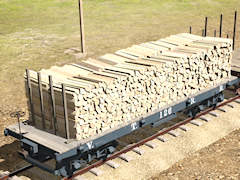
<kuid:124060:15087> 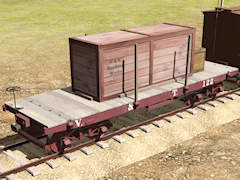
<kuid2:124060:15001:2> |
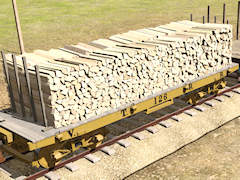
V & T 30' wooden flatcar (Central Pacific)Built for the Virginia & Truckee Railroad in 1872 by the Central Pacific Shops in Sacramento, CA. These cars were built to CP plans, as the CP shops had lost the original 24' Virginia & Truckee flat plans. Initially painted in yellow; by the 1890s, all cars were painted red. There is some discussion that the cars were initially painted a grey / slate color; a version is also provided for that possibility. Version: TRS19 or TRS22 Beta |
|
<kuid2:124060:15007:1> 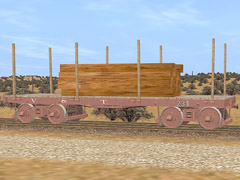
<kuid2:124060:15003:1> |
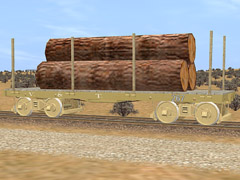
V & T 30' Wooden flat car (Detroit)Built for the Virginia & Truckee Railroad, 1874-1876, by the Detroit Car Works, in Detroit, Michigan. Initially painted yellow, these were painted red by the 1880s. Parts of one of these cars (#134 / old #218) are at the Nevada State Railroad Museum. This car's trucks are now under restored boxcar 1005. Version: TRS2004 |
|
<kuid2:124060:15000:1> |
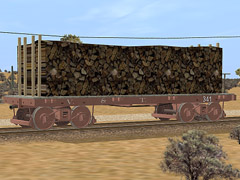
V & T 30' flatcar (V & T rebuild)11 flats were rebuilt by the V & T in 1891 out of old flatcar parts. One of these cars (#162/old #338) is at the Nevada State Railroad Museum, restored to 1905 appearance. Version: TRS2004 |
|
<kuid2:124060:15067:1> |
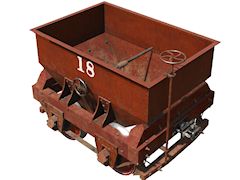
V & T 8-ton ore car (early; 33" wheels)The V&T had approximately 104 of these cars. Some were built locally, some were ordered complete. The first cars built in 1869 had larger 33-inch wheels. These were rebuilt ca 1873 with the smaller 26-inch wheels. By 1917, all were gone from the roster. Includes 5 random textures for variety. Updated July 13 2015 to fix an ARN issue with TANE; as well as some minor optimizations. Version: TRS19 or TRS22 Beta |
|
<kuid2:124060:15016:7> |
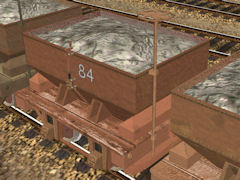
V & T 8-ton ore car (26" wheels)The V&T had approximately 104 of these cars. Some were built locally, some were ordered complete. The first cars were built in 1869. By 1917, all were gone from the roster. Includes 5 random textures for variety. Updated July 13 2015 to fix an ARN issue with TANE; as well as some minor optimizations. Version: TS12 |
|
MoW
| Screenshot | Description | Source file(s) |
<KUID2:124060:15088:2> |
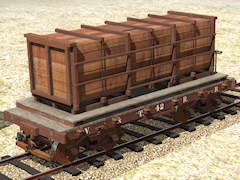
V & T Water Car No. 42One of several water cars built on top of a 24' flat car as early as 1873. This particular car was replaced by water car No. 90/50/1 in 1900, and was converted back to a flat car. Version: TRS19 or TRS22 Beta |
|
Motorcars
| Screenshot | Description | Source file(s) |